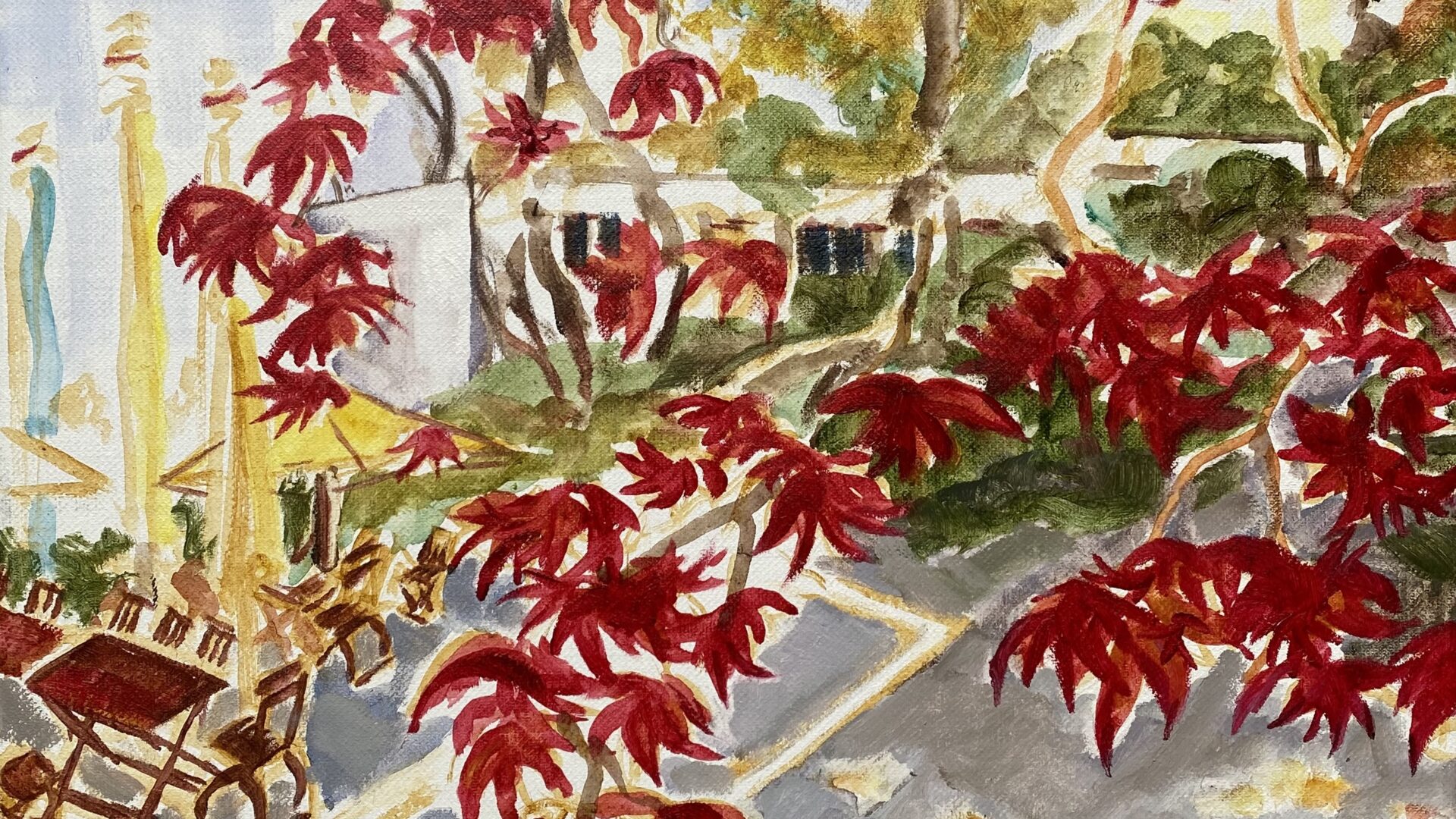
There – Not There
Text by Prof. Dr. Alfons Reckermann published in „There- Not There“ Dorothea Breick, Berlin 2026
A collector has the privilege of developing a relationship with their paintings that comes close to the intimate familiarity one feels with loved ones. I would therefore like to explain, in the form of a brief guided tour through some of my paintings, what I perceive as their inner life. I shall begin with Te me (p. 15), before which I sit almost every evening, often whilst listening to music, but often also in undistracted concentration on what meets my gaze there. The title is derived from Buddhist philosophy and describes „freedom from any limiting relation to something else“. Although the painting depicts part of a landscape in the vicinity of Lerab Ling, to characterise it merely as a landscape painting would be superficial. In reality, we see a composition of colour and form, whereby the painting derives its form solely from the interplay of colours. Colours, in turn, are, in all of Dorothea Breick’s paintings, what Goethe called, „deeds and sufferings of light“ (Zur Farbenlehre, Didactic Part, Preface, Goethe’s Works, Hamburg Edition, 3rd ed. 1960, vol. XIII, p. 315). The zone of the sky, which rises as a significantly larger portion above the terrestrial zone, is a world of light, the setting for a subtly balanced interplay of the most delicate hues, which shimmers so vividly in its central zone between yellow and blue that the colours, to use a musical term, merge enharmonically into one another. Pure light appears only as a narrow strip of unpainted canvas on the boundary between sky and earth. Perhaps a glimpse into a reality beyond the diversity of colour, one that is beyond our grasp. Upon a casual glance—which is sometimes useful—the eye can perceive this strip pulsating rhythmically in such a way that its brightness radiates both upwards and downwards, allowing large parts of the picture plane to breathe in its light. The green of the meadows, the light brown and yellow of the plough furrows—a nod from the painter to van Gogh—or the subtle interplay between white, yellow, green, brown and blue at the left edge of the terrestrial zone: all of this is permeated and held together by the gentle, irresistible power of light. In the refraction it undergoes through the colour, it remains a fact across the entire picture plane, even though darker areas do indeed recede from its brightness. The painter has taken a particular impression of landscape, which she had before her eyes whilst painting, and transformed it, through her artistically productive eye, into an inner image, passing it on to her hand in such a way that, in the eye of the viewer, a cosmogenetic landscape comes into being—one that allows us to share in the „deeds and sufferings of light“, without which there would be no visible world at all. Looking at the parallel image (p. 39) and its related Absence (p. 33), Early Spring (p. 5), as well as Garage Theron (p. 67) and Yangsi (p. 71), it becomes clear that this process cannot be presented in a mode of singular definiteness, but—owing to its inexhaustible diversity—can only be brought to view in a potentially endless series of similar images.
Dorothea Breick’s paintings, with their commitment to representational art, steer clear of the genre of abstract art which, since the early years of the 20th century, has decisively driven the history of painting forward. But what does this adherence to a representational dimension mean for her? It has never been the intention of sophisticated painting to duplicate, through imitation, what we see in our everyday, pragmatic experience. The abstract painting seeks to leave the world of objects behind as far as possible, or, under the influence of psychoanalysis as interpreted by the Surrealists, to show how it might emerge from a dream world of the indeterminate. Painting that remains legible as representational, on the other hand, seeks to present the subject in a light that does not suppress the materiality of the representational, but nevertheless relegates it to a secondary position. In light of the ancient saying by Anaximander (c. 610–545 BC), according to which all existing things emerge from the boundlessly indeterminate and return to it in accordance with the order of time (Frg. A 9, DK 12), it can guide us towards a meditative practice aimed at gaining a fundamental distance from our everyday experience of reality. This relativisation, however, is no devaluation; rather, as in portraiture, landscape painting or still life, it amounts to a particular justification—indeed, almost a transfiguration—of the representational. Dorothea Breick follows in the footsteps of a Cézanne or Monet when she depicts the representational through an interplay of colours and forms in such a way that it remains connected to the reality of pure light. It is about its ‚colourful reflection‘, in which, in the words of Faust at the beginning of the second part of Goethe’s world drama, we alone ‚have life‘ (II 4727).
I would like to illustrate how magically and variously the painter follows this maxim by turning to the pair of pictures Wheat (p. 16) and then to the, in a certain sense, singular picture Imagine (p. 19). In the first case, the identical titles refer to the readily recognisable representational subject of a wheat field. But what is actually being shown? If we were to see only what the title says, we would have remained outside the picture, but would have failed to enter its inner world. The first thing that strikes one is that, in both cases, the recognisable section of the wheat field is scarcely grounded. In the first version in particular (p. 16), it seems to float freely between sky and earth. Instead of the ground, the foreground is dominated by the pure white of the canvas, punctuated by lightly dabbed nuances of the primary colours—yellow, red, blue—and their mixtures. Nothing coalesces into a definiteness that would supplant or exclude anything else. A similar effect can be observed at the height of the wheat ears’ tips—that is, in the sky zone, which thereby exerts a powerful influence on the foreground, yet in accordance with the law of interaction. With great vigour, an elongated blade of grass on the left, surrounded by an aura of white, points towards the sky zone, which shifts between white, pink and blue. The wheat field is dominated by shades of yellow and brown lightened towards red, interspersed with the interplay of blue and green from the cornflowers lying across it, whilst the tips of the ears of wheat, particularly on the left-hand side, seem to merge into yellowish cloudlike forms. In the second painting, a similar representational principle prevails, except that the colours are applied more vigorously. In return, the material texture of the painting surface is more clearly discernible, which lightens the colour stripes and thus prevents them from appearing too dense. As the eye roams freely, it repeatedly encounters enchanting interplays of colour that seem almost entirely self-contained. So here too: A wheat field, yet fully integrated into an inexhaustible interplay of and with multiple colour forms that are, however, always transparent towards the white. In the second painting, the cornfield is structured vertically by a free alternation of densification and lightening, whereby the light areas seem to recede whilst the darker ones come to the fore.
What is unique about Imagine? The title itself appeals to our imagination whilst simultaneously referring to its origin in the painter’s own imagination. What we see is a free floating of colour forms without any connection to a spatially identifiable surroundings. Here, it is particularly important to pay attention to the ground layer, which underlies the entire picture surface with delicate areas of yellow and pink. The white of the canvas takes us even further back into the realm of the indeterminate, enveloping the picture’s floral forms like an aura. Against this largely indeterminate background, twigs and floral forms seem to float freely, as if in a dance. Everything definite remains transparent to the indeterminate, from which it stands out without obliterating it. In some places, it is impossible to determine whether a flower, a leaf or a twig is dissolving into this indeterminacy ‘according to the order of time’ or emerging from it. I see in this picture the depiction of a dreamlike apparition, the emergence of a world of absolute freedom, in which all forms stage a play that, whilst reminiscent of the concrete world, is not of this world. We are spectators of a play of which the picture can show only a small fragment, whilst the composition of the picture’s edges suggests that this play continues beyond them, without limit, beyond what we see. The few—and therefore particularly precious—floral forms, in which the colour blue dominates, are splashes of exceptional beauty. This is countered by the intertwining of the freely criss-crossing branches, which, severed from trunk and root, remind us that the play into which we are granted a glimpse can only be sustained in the world of dreams. How many shades of brown there are there! They are answered by a dance of golden-yellow blossoms, which perhaps enchant not only me, like greetings from a paradisiacal world. This magnificent interplay of colours is, once again, shaped by a wildly dynamic sky section—virtually the opposite of that in Te me.
There are, within Dorothea Breick’s œuvre, other accents too. Silver Sky Walk (pp. 62f), for instance, is marked in its middle zone by vigorous, opposing strokes of colour—accented in pale green towards the upper right, shading into dark reddish-brown towards the lower left. A further accent is given to the picture surface by trees, above all by the bare tree placed at its centre, which extends its boughs and twigs so far into the grey zone of sky that some of their tips seem almost to dissolve in an aureole of yellow and white. In the middle zone of this picture I see a homage to the late van Gogh. The path, too, poured unevenly in pink across the foreground, curving backward in an S-shape before turning steeply once more towards two isolated standing trees, reinforces the threatening unease palpable in this picture. This expressive dimension is intensified above all in the central panel of the triptych Men, Torma, Rak (pp. 64f). It confronts us, unmistakably, with a zone of death, one that continues across both side panels, and above all on the right. On the left, a few lighter passages can be discerned, taking up what is suggested in the background of the central picture. But this does not alter the fact that what is depicted here are the Dionysian forces of nature, in Nietzsche’s sense, which counteract everything that might in any way appear as a stable or even Apollonian, illuminated form. This dark expressive dimension is again given free rein in the magnificent Hill Top View(pp. 44f). Above the white of the foreground, a wild low-mountain landscape takes shape, composed of valley gorges through which a road runs, almost like a waterfall, as well as sections of woodland and meadows that merge into one another in the liveliest of alternations. This cosmos of wildly interplaying colour forms is dominated by the higher mountain ranges of the Cévennes and a section of sky that towers above them once more. Towards the upper edge of the picture, the chromatic dynamism of the central zone is gradually subdued; yet it retains its expressive power by appearing to float as a world of its own between the lower edge—left devoid of colour—and the upper edge of the picture, which transitions the colour chromatically into pure brightness.
I would like to cast one final glance at the diptych Chöying dzö (p. 34ff). I am struck, again and again, by how sky and earth are here set in sharp contrast to one another and yet mutually interpenetrate. ‘There – not There’ could also be a title for this painting. All colours, in whatever nuance they appear, are „deeds and sufferings“ of light. Admittedly, the painting is also, in part, a representation, in that it shows how the Buddhist temple at Lerab Ling is integrated into its natural surroundings. Yet I see in it, above all, a depiction of what one might conceive as the very core of the reality in which we live. Perhaps, in a patient, exploring look at this diptychon, one might perceive a sound that comes close to what one might imagine as the absolutely over-complex ground-tone of the world. It seems to me that the painter has allowed this sound to resonate within her for a long time and has expressed what she perceived in this way through colour and form.