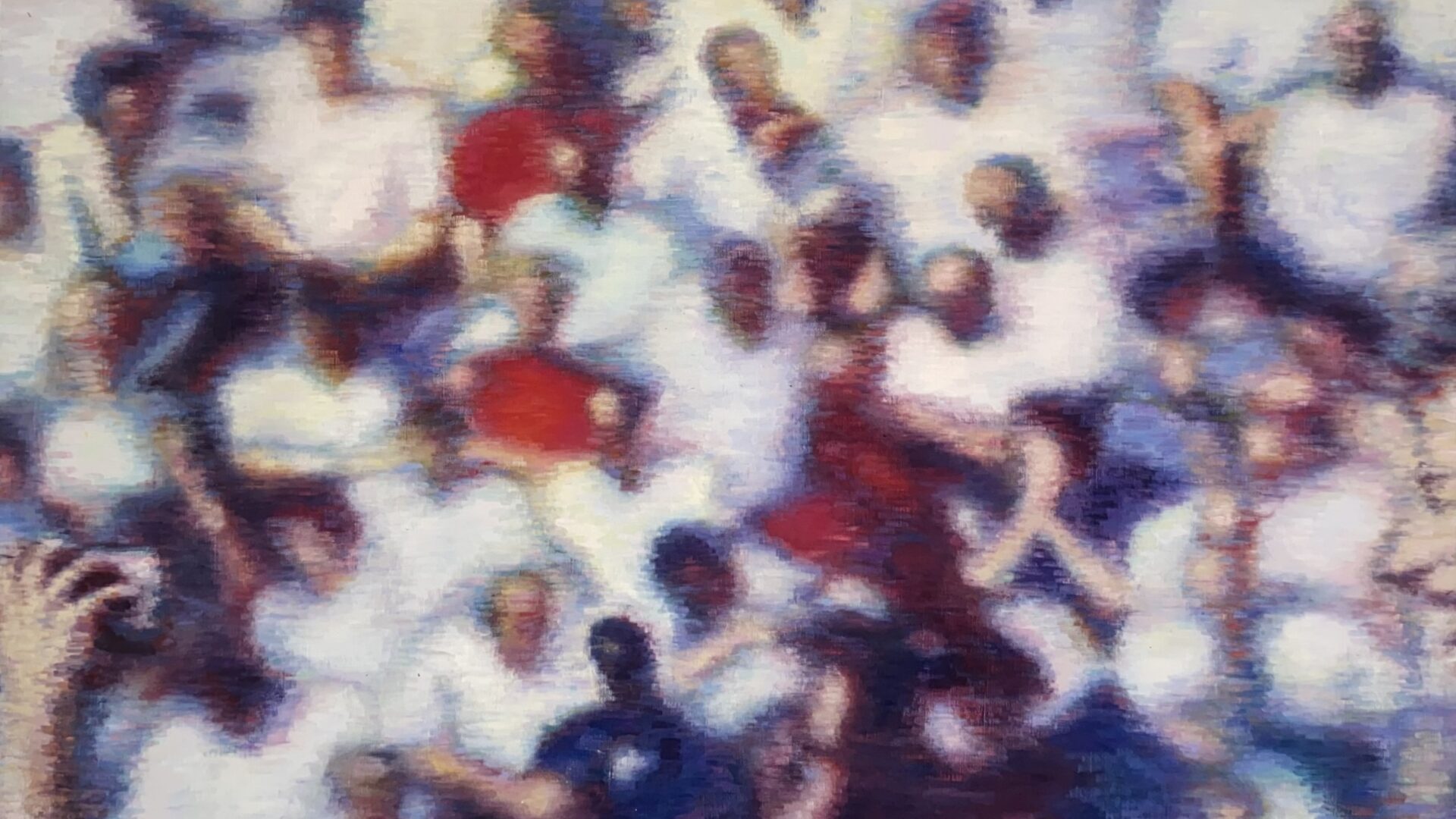
In 1987 Dorothea Breick began investigating how illusion is created on a television
screen in order to understand how illusion is created more generally. At the time, she
used a video camera to capture her visual experiences and began creating
photorealistic oil paintings on canvas based on video stills. She playfully imitated the
electronic process of image-making because she was overwhelmed by the rapid
changes in her field of vision and needed a skillful way of recording them.
She also needed to slow them down, or pause them. It became essential to recreate the
experience in her studio because painting directly from observation was too slow to
keep pace with the fleeting changes in what she was experiencing.
She did not want to use photography because it captures only a single slice of reality—a
version that is too static. She wanted to record the succession of disappearing moments,
the constant shifts in perception, the continuous flow of experience. The photographs
she took always contained so much that she had never actually seen, which she found
rather disorientating.
Instead, she used a video camera to record her experiences. The softness of the video
stills proved helpful in painting, allowing her to dissolve forms into color and soften the
boundaries between shapes.
It was only much later, around ten years afterwards, from 1997 onwards, that her
paintings were created without photographic aids, based instead on sketches and direct
observation, painted in oils on canvas in immediate dialogue with her field of
perception.
The television screen images were the first works through which she realized how
constantly self-deception shapes our experience. By silently recreating the appearance
of reality on an ordinary television screen and then translating that illusion into oil on
canvas, she reflected on how the process actually works.
How can something appear so real when it is, in essence, only light—simply white, red,
green and blue?
She gradually came to understand that our own perception is always a projection in
much the same way: a play of light, a film that we create and then respond to – magical
and unfathomable.
She wanted to make this process of realization accessible to others—illusion observing
illusion—and to experience it again and again through drawing and painting in oil on
canvas before sharing it with others.
The spectator paintings from 1989 and garden scenes series from 1990 are the
outcome of this research.
At the time, she was entirely unfamiliar with Buddhist ideas of emptiness. Yet it became
increasingly clear to her that what we see possesses no inherent substance.
We continually deceive ourselves into believing that what we perceive is reality itself,
when in fact it is a fiction generated by our habitual patterns of perception.Every one of
us creates a unique world of appearances. It is remarkable that we can communicate at
all, and perhaps unsurprising that so much misunderstanding exists.Most of the time, we
see only what we think.
Painting, however, can become a process of arriving at a way of perceiving that lies
beyond concepts. It becomes an act of simply seeing, beyond labels and definitions. By
letting go of labels in the presence of beauty and ugliness, of the richness and density
of reality’s continual transformation, seeing itself can emerge without judgement and
become a direct, living experience. A close friend of hers calls this „non-identifying
seeing“. It is something that can be cultivated, and it is deeply rewarding when it
happens.
When she created the spectator paintings in 1989, she was fascinated by crowds
watching football matches. People cheering, shouting, booing, joining in, or simply
watching quietly. They appear captivated by what they see: a colorful, pulsating, vibrant
and emotionally charged spectacle. Yet they become so absorbed in looking that they
forget they are looking. They become involved, take sides, and forget that it is only a
game.
Are we not much the same? Do we not also forget, most of the time, that what we see is
itself only a game created by our own perception?
We are like them.
Them is us.
Looking at paintings offers an opportunity to become aware of seeing itself, so that, for
timeless moments free from concepts, pure seeing may arise without judgement and
become a direct, living, conscious experience.
Simply look. See. Feel. Let every label drift past.
In this exhibition we see the paintings of the many spectators placed in the presence of
a large statue of the Buddha. How do these two elements belong together?
According to Buddhist understanding, there is only one essential difference between
enlightened beings—the Buddhas and Bodhisattvas—and ourselves.
They have seen, recognized and fully realized their innate wisdom nature. That same
original wisdom is equally present within us, but we fail to recognize it, or glimpse it only
occasionally and incompletely, repeatedly falling prey to the deceptions of our own
perceptions.
They remain aware of perception itself and are therefore not deceived by it; they
possess genuine freedom of choice. We, by contrast, are usually unaware, fail to make
use of our innate freedom, and react habitually. As a result, we become entangled in
endless mental patterns and the chains of action that follow from them, constantly trying
to prove our existence. Yet, in terms of our fundamental nature, there is no difference
between them and us.
Fundamentally, we are like them.
Them is us.
In this spirit of non-separation between ourselves and those who have fully realized their
potential, the central work in this exhibition is the pencil drawing displayed over there.
It is a portrait study of Khandro Tsering Chödron, and the only portrait study Dorothea
Breick has made during the past twenty years.
Khandro Tsering Chödron was one of the greatest woman masters of our time, and
Dorothea Breick was extraordinarily fortunate to be part of the team that cared for her
during the final years of her life. She describes her experience:
„Being with Khandro was like looking into the open sky. Everything about her was
completely natural; nothing was contrived. Her transparency was so complete that, when
sitting beside her looking through a book together, I sometimes found myself turning to
check whether anyone was still sitting there beside her at all. Her mind was utterly still,
unmoving and unchanging.
Being in her presence offered no frame of reference. There was nothing to support a
sense of personal identity. Everything simply fell away. I myself did not seem to exist, just
as Khandro herself seemed beyond any fixed existence. There was only profound mental
freedom, clarity and deep silence. For Khandro this was entirely natural; for me it could
often feel profoundly unsettling—so much space, so much freedom, such immense
silence. It could even be frightening.“
According to Buddhist understanding, the self—the „I“—is itself an illusion: an everchanging
accumulation, an intangible process, empty of any inherent substance, to
which we attach a name and an identity. It is pure fiction. Yet within that fiction lies a
primordial capacity for knowing—a fundamental cognitive awareness. At the very heart
of our apparent non-existence is a fundamentally good and luminous essence that
knows its own selflessness. It is up to each of us to sense this essence, remain in contact
with it, and gradually realize it.
For this reason, it is our responsibility to cultivate contact with this knowing empathy
within ourselves, free from neurosis and limitation, so that we may come to understand
the true nature of things. This potential of the mind does not need to grasp at objects
and solidify them into fixed things. It can simply see. We can learn not to fall
automatically into belief or doubt, hope or fear.
We can learn to perceive what is unpleasant or unattractive—both in others and within
ourselves—while knowing that these aspects are never the whole story, and that there is
always a more spacious way of seeing.
There exists an unobstructed and deeply respectful way of seeing the world, of seeing
ourselves, of understanding what is happening and recognizing what truly is.
This pure, non-identifying way of seeing gives us the freedom of choice – to respond in
ways that create grace, clarity and kindness—for ourselves and for others.
After all,
Them is us
Dr. Madder Brown, London 2025