In Seeing and Observing
Text by Dr. Thomas Hirsch, recently published in
https://www.boesner.com/kunstportal/kunst-und-kuenstler/portraet/dorothea-breick/
It is magnificent how effortlessly these paintings capture an overview of reality, while simultaneously fragmenting into a multitude of details and atmospheric nuances! How closely and precisely chaos and order coexist here! Dorothea Breick’s painting style is vivid and fluid, characterized by luminous colors that allow her to transcend the representational nature of her subjects, while capturing the very transitions between one situation and the next.
She maintains a respectful distance—a vantage point that offers a broad perspective—while deeply engaging with what she sees and presenting it to us as an invitation to contemplate.
Her focus is primarily on landscapes and nature, though—much like in her early years—she has recently returned to depicting urban scenes that point directly to human life. She hones in on places of public activity: once, it was boys playing street basketball; today, it might be a scene on a park lawn, or a view from above looking down onto a sidewalk—fleeting moments that reveal so much about how we live and the nature of our society.
There is a specific reason to write about Dorothea Breick right now: a few weeks ago, a delightfully compact catalogue of her recent work was published. It was designed by Lena Mozer, whose graphic finesse also shaped the three preceding catalogues, which document the artist’s paintings, watercolors, and drawings from her beginnings in the late 1980s.
The recent Publication There – Not There features, for the most part, small-format works created over the last decade. There are many reasons for this book—not least the quality of the paintings themselves, as well as the reserved nature of Dorothea Breick, whose works one rarely sees in exhibitions.Then there is the shift in her living environment. In addition to her residence at Lerab Ling—a traditional Tibetan Buddhist monastery complex in the south of France, near Roqueredonde—she also lives in Berlin’s Westend, home to the RIGPA center, Dharma Mati.
In both places, painting serves as a means of engaging with and experiencing her immediate surroundings—immersing herself deeply in her observations whilst transcending them. She approaches the small details while keeping the larger picture in mind.
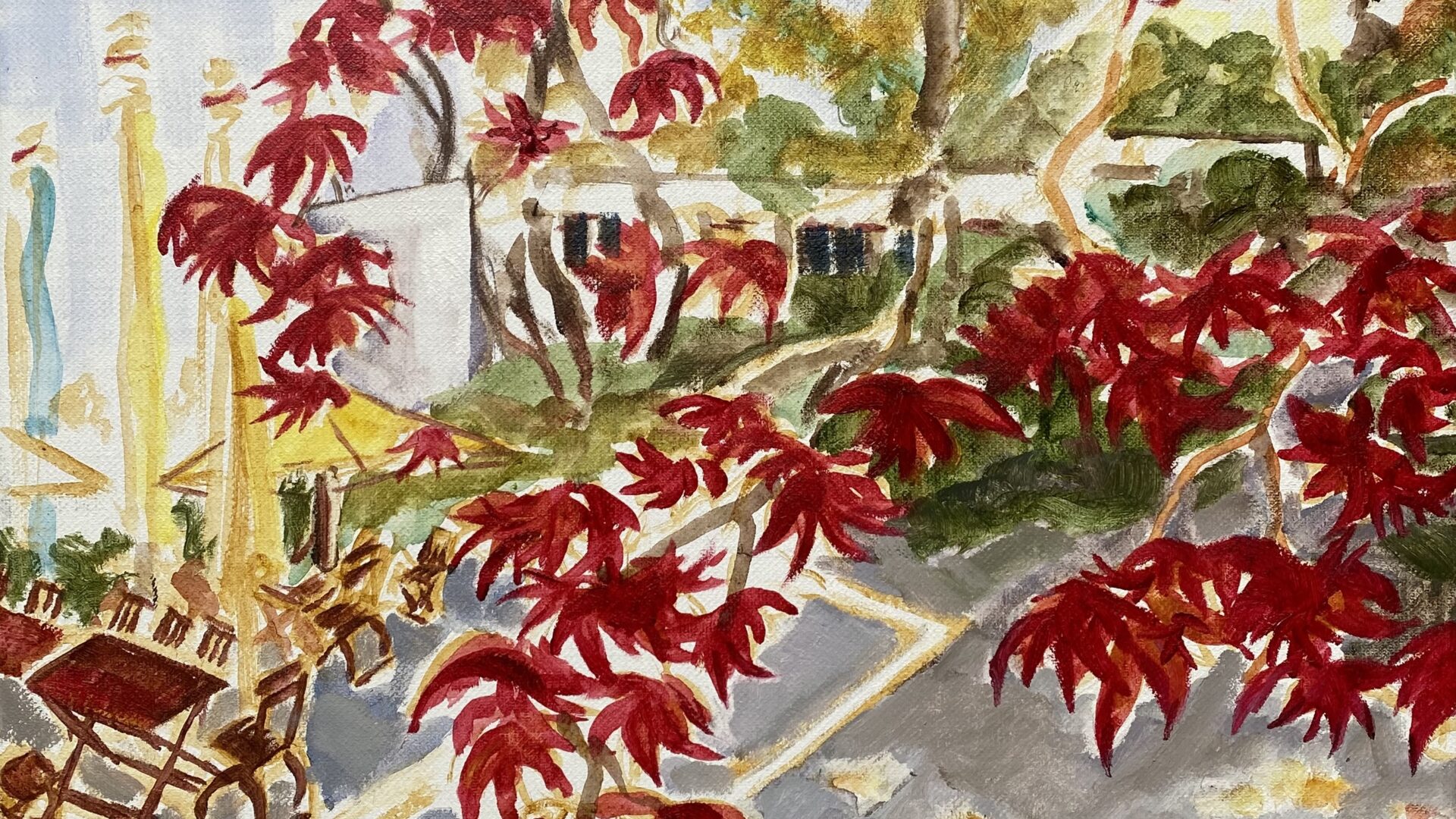
An example of her recent work in Berlin can be seen on the exhibition catalogue cover: “Rikjema” (2025; the title refers to a meditation deity in Vajrayana Buddhism). From a window on the top floor of Dharma Mati, one looks out onto a sun-drenched terrace, complete with tables and chairs, situated behind the stately building. Framed by shrubbery and the surrounding architecture, the scene is partially obscured by the branches and leaves of a tree positioned between the window and the garden. Reminiscent of a mobile, and rendered in an impressionistic style with earthy red-brown tones, the leaves—each individually celebrated through the act of painting—tilt in various directions. They shimmer in correspondence with the golden-yellow foliage on the ground below, as if one were the light-and-shadow reflection of the other. Patches of light illuminate this secluded space, beyond which the sky emerges. Though no people are visibly present, their existence is suddenly evoked through the traces of nature—enough to bring the scene to life and fill it with the suggestion of conversation and laughter.
Here, as elsewhere in Breick’s paintings and drawings, a realism that is both dynamic and contemplative opens up resonant spaces for seeing and feeling, for remembering and looking ahead. To achieve this, she selects familiar situations and and conceives them from a bird’s-eye view — one that is always, inherently, a personal perspective. In doing so, she reflects—without the need for explicit elaboration—on societal and social contexts, on how we live together, and on the nature of individuality within our urban civilization.
Since her beginnings in the 1980s, Dorothea Breick has been concerned with the everyday process of settling into life. She has, for instance, documented her domestic surroundings in her paintings—such as the view of a courtyard, taking in a balcony across the way. Mundane objects found in a kitchen or living room are transformed into multi-layered still lifes, rendered with a gentle, attentive regard. The domestic scene becomes a stage where the relative scale of objects shifts; suddenly, an entire cosmos of relationships—and the conceptual associations and meanings that accompany them—unfolds. Porcelain vessels, with their specific imagery, forms, and colors, take on the roles of rulers or companions; they become proxies for our interactions across different cultures—all without Dorothea Breick imposing such a narrative, and without it being immediately or superficially apparent in the objects themselves.
In the years following 2000, she began incorporating portraits. Her subjects are her family and friends—people with whom she shares a relationship built on trust and understanding. She refers to these portraits as „one-on-one,“ describes them as a form of dialogue, and emphasizes the equal standing of both painter and model. In a conversation in Berlin, she noted that all her paintings—even those from earlier periods—have always been created solely through direct observation, never by using a photograph as a reference.
She explains that an internal image is also at play—one that must be reconciled with the external reality, yet always captured in its essential truth.
Her models span various generations, ranging from a small child with its mother to an elderly woman. The skin, with its folds and varying tones, serves as a vehicle for expression. Beyond capturing individual character—the interplay of facial expressions and gestures, the presence of the subject with or without direct eye contact—the fabrics worn by the sitters also take on significance through their tactile quality, color, and patterns. Her familiarity with Tibetan Buddhism—with its vibrant festival colors and the fine textiles of its ceremonial robes—has surely contributed to this heightened sensitivity.
Since 2006 Dorothea Breick spends a great deal of her time a monastery complex in the south of France. She has maintained her connections with family and artist friends, even during periods of complete seclusion. Particularly at Lerab Ling, she continues to create works with a watercolor-like quality, depicting ritual objects or personal belongings—such as a gleaming mala resting on an armchair draped with blankets and cloths, or her own watch and glasses left on a bedside table. These still lifes are also characterized by a sense of solemnity—a quality that is both luxurious and unique—enhanced by the lighting, the richness of the colors, and the volume of the fabrics depicted.
Outdoors, where the vastness of the sky is made palpable by a low-lying horizon, a different set of rules comes into play. A wonderful example is the 2019 work „Te me.“ The luminous, almost transparent sky occupies three-quarters of the painting. Beneath it, the landscape of the Cévennes—rendered as cultivated fields with distinct, broad, fibrous strips—appears in a summarized, almost geometric arrangement. Only in the far distance does a patch of green, resembling a small woodland, emerge.
The intensity of the individual brushstrokes—alternating between acceleration and sudden stillness beneath the vast sky—suggests a potential point of contact between earth and heavens, as well as a sudden sense of vulnerability. The Tibetan term „Te me“ translates roughly to „free from any reference.“ Though the format of this painting is modest (50 x 70 cm), it possesses a monumental quality, rich in profound stillness.
In other works, Breick focuses entirely on individual blossoms and shrubs at various stages of blooming and fading.
From 2020, alternating with stays in the south of France, she moved from Düsseldorf into the flat in Berlin, from which she also paints the world outside. Urban structures and phenomena of city life come into view, serving as a frame of reference and shifting the viewer’s perception. Cars parked beside a high curb, for instance, suddenly appear enormous—as if they might drive off at any moment. Her gaze captures passersby in a sketchy manner, while also discerning the intricate, foreshortened construction of baby strollers. She positions herself with her painting supplies at the edge of a park meadow, her eyes sweeping across the grass and its metallic borders.
Yet, while in the Cévennes she captured moments of eternity—imbued with a sense of absolute stillness—she has returned here to painting the transient, a quality that also defined her time in Düsseldorf. The seasons and the times of day, along with the shifting light, play a significant role.
The paintings of the Wannsee (2024) are rendered from the same sweeping, panoramic perspective as those of the surroundings of Lerab Ling; however, the nature and the prevailing mood are distinct—the sky is obscured by passing clouds, which are reflected in the water. The natural landscape and the shores of the Wannsee are likewise composed of a multitude of restless, energetic brushstrokes. A sense of empathy and meditative focus remains palpable. Through an oil-paint application that evokes the fluidity of watercolor, everything is perceived and rendered with remarkable lightness. Nothing here asserts its own importance, yet each element persists as an integral part of life, giving it presence.
Dr. Thomas Hirsch